
After 32 hours of travel we landed in Johannesburg. We spent a quick day and night there, mostly sleeping, and flew the next morning to Antananarivo, the capital of Madagascar. I had a nasty cold and Rich was still feeling the travel so we didn’t do much in Tana. The next morning we flew to Morondava on the West Coast.
Madagascar lacks transit infrastructure so we are doing tours here with a driver/guide. We were met at the airport in Morondava and brought to our guesthouse on the beach. The white sand, palm trees and clear blue ocean were the perfect backdrop for a lazy afternoon.
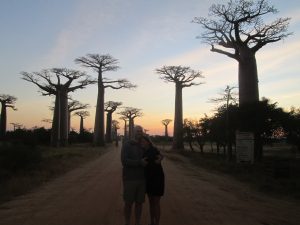
The next morning we departed at 5 am to make it to Baobab Alley in time for sunrise. There are seven types of baobab trees in Madagascar. Three of them are found on Baobab Alley. Watching the colors illuminate the huge trees made the early morning wake up totally worth it.
Next stop was Kirindy park where we did a nature walk and saw our first lemurs- red breasted lemurs and sifakas. We were able to watch them leaping from tree to tree playfully for a few minutes before continuing on the walk. Near the parking lot we saw a fossa-Madagascar’s largest carnivore, about the size of a medium dog.
We had two river crossings on our journey whch we made on ferries. The ferries are wooden slabs attached to a motor. The ferries can fit one to six 4WD vehicles. None of the roads on this journey are paved so 4WD is necessary. Foreigners are not permitted to drive in Madagascar so you must hire a driver with your vehicle. I can see why- even paved roads are in very poor condition here.
We arrived in Bekopaka around sunset. We had dinner at our guesthouse and crashed. The following day we drove two hours on a road so bumpy it made the Nepali road from Jomsom to Beni seem flat. Then we arrived at the Tsingy de Bemaraha. A tsingy is a natural rock formation left over from when the area was under the sea- you can see sea creature fossils in the rocks. We put on climbing harnesses for our trek/climb through the Grand Tsingy.
Even though the route is only 3 km, it takes three to four hours to complete. After a short walk through the woods we descended into the rocks. Parts of the trail go through caves that require flashlights. Sometimes we crawled. From the bottom, we climbed, literally, on rocks, often clipping into cables as we ascended over rocks and up ladders. The view from the top of the tsingy was breathtaking.
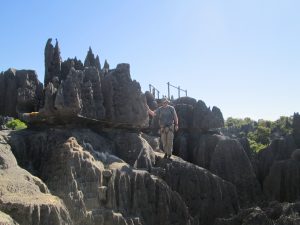
After a short rest at the viewpoint, we crossed two suspension bridges and began to descend. Once at the bottom we walked through the forest and saw two red tailed mongooses, two noctural lemurs, and a couple of sifakas. It was hard to believe we did all that and were back at the hotel by 2 pm. That evening, our guide, Yves, took us on a night walk where we saw three different types of chameleons.
We drove back to Morondava the next day along the bumpy road. We stopped on the way to see a double baobab and also saw a sifaka and a mouse lemur, the smallest lemur. We stopped again at Baobab Alley for sunset.

We flew back to Tana the next morning and started our second Madagascar tour. This one takes us through Eastern, Central and Southern Madagascar. We met our guide, Mr. Fali, and headed to our hotel in Tana. We had some free time and wandered a bit in central Tana, but rain cut our escapade short. Hopefully we’ll see more of Tana at the end of our trip.
We departed after breakfast for the drive to Andasibe. There are a few different parks in Andasibe and it is best known for being the habitat of the indri indri, Madagascar’s largest lemur. Spoiler alert- we didn’t see any. On the way we stopped at Madagascar Exotic Park where they have many of Madagascar’s chameleons, lizards, and frogs on display, as well as ginormous moths.
We took an afternoon walk in the park where we spotted a new (to us) type of sifaka and a couple of sleeping bamboo lemurs. We did a night walk and saw more chameleons and caught a glimpse of a mouse lemur.
The next day we had a three hour walk in Mantadia park about an hour from our guesthouse. Unfortunately, as often happens in the rainforest, it was raining. Early in the hike we heard the eerie, remoreseful sounding call of the indri indri (sounds a bit like the song of the humpback whale) and we headed across te valley to find them. Unsuccessfully. We did see red breasted lemurs and a quartet of sifakas that we observed for 10 minutes or so. We also experienced a less welcome forest critter- leeches. Rich had one on his hand and I got three on my arm and legs. Evil creatures!

On the drive back to Andasibe town we stopped at “lemur island” in Vakona, a private reserve owned by the Vakona Lodge. There are three types of lemurs on the island and they are not shy! They jump on visitors’ shoulders, chests and heads in hopes of getting bananas from the guides. Rich and I had a blast playing with and observing them.
I think that’s enough for this post. More on our Malagasay adventures soon!


Nancy
June 25, 2016 — 4:39 pm
Hip hip hooray. Another posting. Madagascar sounds like a challenging place, between the roads, rocks and leeches. However, staying on a beach makes up for a lot (as does playing with lemurs) .